Built around a person, not a workout

An assistant that
knows what
you need

Sleep, food, training and how you feel — in one place. In the morning Noma tells you in one sentence what your body needs today, and why. Log food with a photo or your voice, sets with your voice. Over time the app learns what works for you: after which nights you’re stronger, and how protein and creatine affect you.

No questionnaire No account to start No watch needed
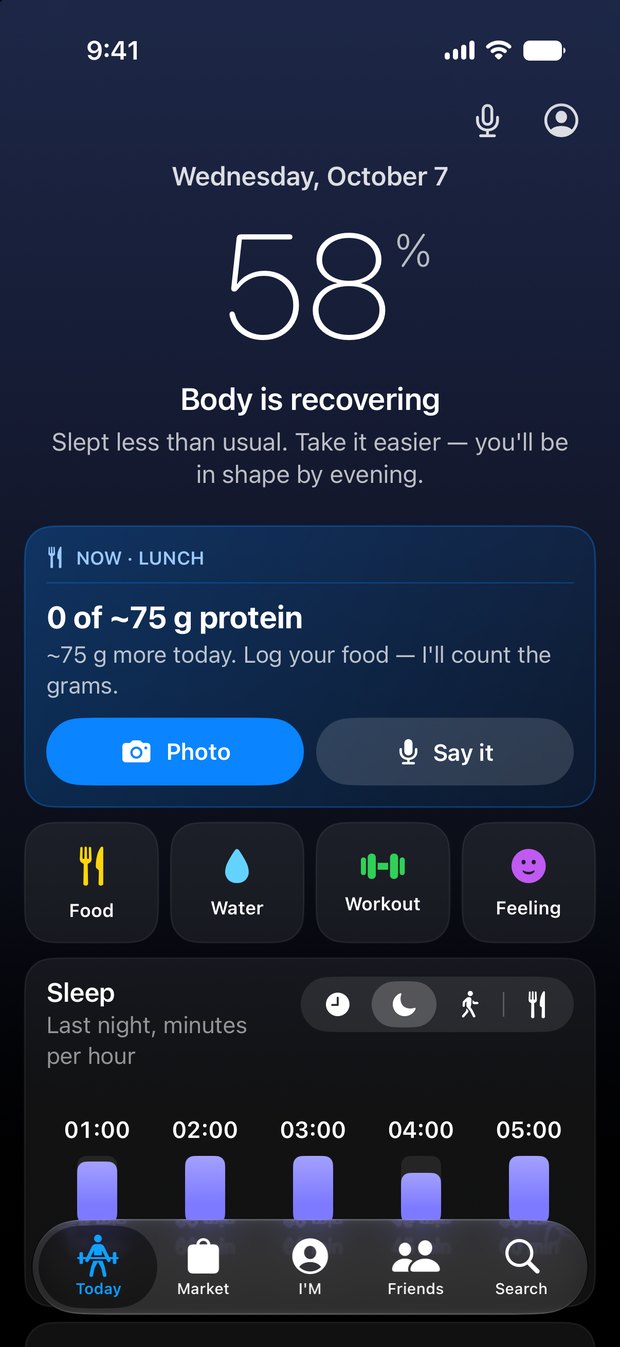
The NomaSports Today screen: readiness, what to do now, buttons for food, water, workout and how you feel, sleep by the hour.
A real screen. The recovery figures are sample data.
Why us

Advice, action and result —
in one place

A tracker knows your body but says nothing about food. A calorie counter knows your food but not your body. A shop sells you a jar without knowing if you need it. Here all of it is connected.

One sentence instead of a screen of numbers.

Not “sleep 6:10” but “you slept less than usual — no extra weight today, coffee before 2 pm”. Tap it to see why, and what it’s based on.

Speak and snap instead of typing.

“Noma, forty by twelve” — the set is logged. Snap a plate or a label — calories, protein, fat and carbs are counted.

The Body Book.

The app checks what you did — sleep, protein, creatine — against what followed: how you felt and how strong you were. Conclusions come only from your own days, and only once there are enough of them.

Not just the gym.

Running, court, walks, home — any effort counts. No watch needed: your phone already knows steps and sleep, the rest is one tap.

A shop that sells what it advises.

“For you today”: protein after training, electrolytes in the heat — with an honest line, “ordinary food works too”. Reviews only from people who bought.

Your data stays yours.

Sleep and pulse from your watch or Health never go to any outside AI. Numbers about your body come from fixed rules, not a neural network. An AI reads only what you photograph or say yourself: a label, a blood-test report, how you slept. It shows you the result to check. Blood-test results stay on your phone. No ads, and screen space can’t be bought.

One morning

What it actually
looks like

Tuesday. You slept badly and you are already arguing with yourself about going.

You open the app. It says you slept about an hour less than you normally do, so today is not the day to add weight. Same weight as last Tuesday, twelve times, three rounds. Go.

You get there. The machine you need is free. You know it is the right one because you saw two people from your gym use it in a video the night before.

You finish a set and say out loud, “twenty kilos, twelve.” That is it. Written down. Your phone stays in your bag.

Thursday it tells you to add two and a half kilos, because Tuesday went fine and you slept properly. That is how the weight goes up: on purpose, not by accident.

Nine weeks of thatThe weight on the bar is different. So is the way your clothes sit, and how you feel on the stairs. Nobody hands you that in a week, and no app can do it for you — it just stops you wasting the months.

How it knows

It watches you,
not the average person

Three things, and none of them is a questionnaire.

Your night

Your watch already recorded how you slept. We take that, compare it with your own usual night, and let it change today rather than just sit there as a number.

Your last load

What you lifted and whether you said it felt easy or hard. Minutes of load from your watch — a run, a court, a pool — go into your water target. That answer does more work than any chart.

Your own normal

Not a table for your age. After a few nights the app knows what a good night looks like for you, and what a bad one does to your Tuesday.

Then it says it the way you would: “You slept less than usual, so we are keeping the weight the same.” No charts, no percentages, no words you have to look up.

Why now

Almost everyone has data about their body.
Almost no one has an answer

Your phone counts steps, your watch measures sleep and pulse, apps count calories. Each shows its own slice of numbers, and none tells you what to do with them today.

Fitness app methods came from people who compete. An ordinary person doesn’t need that load: they quit and think the problem is them.

For ordinary people

Beginners, people coming back after a break, people who never go to a gym.

And for women especially

Cycle mode, privacy, no comparing bodies, no rankings.

Who you do it with

It’s rarely the plan that brings you back. More often it’s someone noticing you weren’t there on Thursday.

What you get

Six things, from
your first day

01

One clear answer, every morning

This movement, this weight, this many sets. Underneath it, the reason today looks different from last time. Nothing to follow, nothing to buy.

02

Never type between sets

Say it out loud and it gets written down. "Three by twelve, twenty kilos." Your phone can stay on the bench with the screen off.

03

Snap it instead of typing

Point the camera at an unfamiliar machine and we name it and suggest today’s weight from your history. Point it at a plate or a label and we count calories, protein, fat and carbs. Point it at a supplement jar and we add it to your list.

04

See how other people do it

Ordinary videos, attached to the exercise itself. People in ordinary gyms, not influencers in a studio.

05

Your body, in plain words

"You slept about an hour less than usual, so we are keeping the weight the same." No chart to interpret.

06

Find people in your own gym

Groups, challenges and meet-ups with people who train where you train.

Your voice assistant

Just say it.
It’s written down.

Call it by name and talk normally. It writes down the set, opens whatever you asked for, closes the workout and starts your cardio.

It works with the screen off, through headphones and in a room full of noise. The recognition happens on your phone, so the audio never leaves it. Longer phrases send the recognised text, never the recording, to a language model that reads it.

Most people quit the log in week two. It’s the typing.

You say

Noma, three sets of twelve on the lat pulldown, twenty kilos→ Logged against the right movement, with your weight.

You say

Noma, I’m done→ Workout closed and summed up.

You say

Noma, going to the treadmill→ Opens your cardio card, ready for the minutes.

Someone else’s conversation

…that’s a personal record, twelve…→ Ignored. Without the name, nothing is written.
See how it’s done

A feed that’s
actually useful

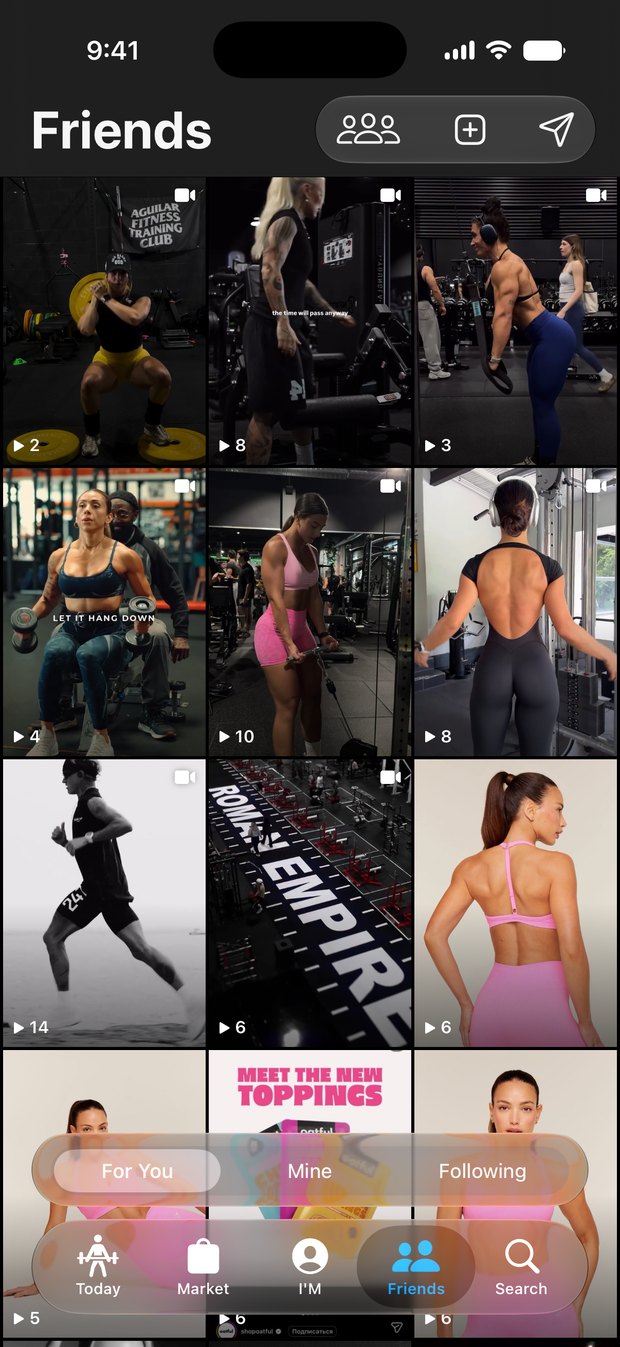
Every video is attached to an exercise. Open the lat pulldown card and you see people doing exactly that movement — what they lift, how they set the machine up, what they call it.

Tags are free text, so people label things the way they say them. If someone tagged it “the one with the ropes”, that phrase finds it.

Nothing here decides what you ought to be looking at, and nobody is ranked against anybody else.

The NomaSports feed: videos from people training in ordinary gyms.
The feed, as it looks today.

What the app says when a machine has no videos“Nobody has filmed this machine yet. Yours would be the first thing someone sees when they don’t know what to do here.”

Your people

The first month is easier
with someone waiting

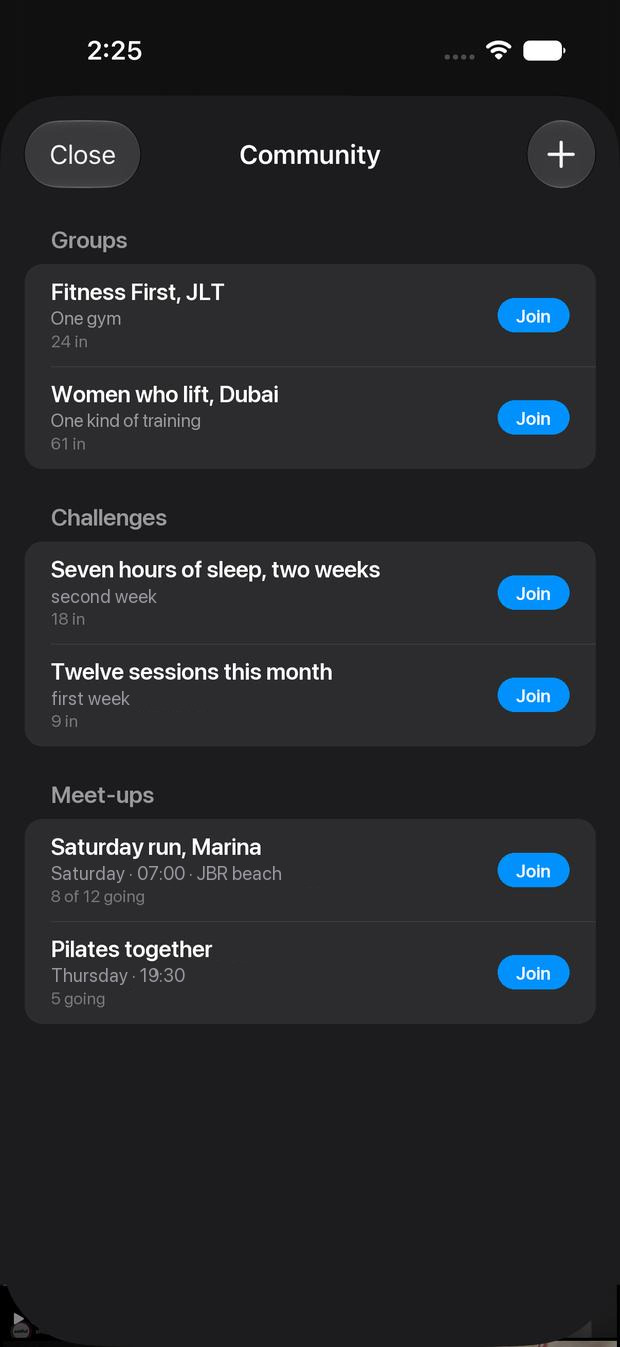
The people in your gym, doing what you’re doing. Groups, challenges and meet-ups live inside the app, not in a chat somewhere else.

Groups

Set up by gym, or by the kind of training you do.

Challenges

Seven hours of sleep for a fortnight. Twelve sessions in a month. A number, a date, and other people doing the same thing.

Meet-ups

A run, a class, a court booking, a session together. Spots are actually held, so a full meet-up really is full.

Messages

The person whose video helped you is one message away. Ask them what they started with.

Community in NomaSports: groups, challenges and meet-ups
The community screen. The entries in it are sample data.
Your body, explained

Your watch counts.
We explain.

Apple Health, your watch, your scales, Oura, WHOOP — they measure all night and hand you a screen full of figures in the morning. Correct figures. And completely useless on their own, because nobody tells you what any of it means for the day ahead.

That is the part we do. You slept less than usual. Your body is where it normally is. Today is fine to train, and we are not adding weight. One sentence, in the words you would use yourself.

We compare you with yourself. The same figure means one thing for one person and something else for another. So we learn what is normal for you from your own nights, not from a table for your age.

64Your variability
7h 38mYour sleep
58Your resting heart rate
3Nights to a baseline

The benchmark is your body, not an average for your age.

The shop

Gear and supplements,
without the advertising

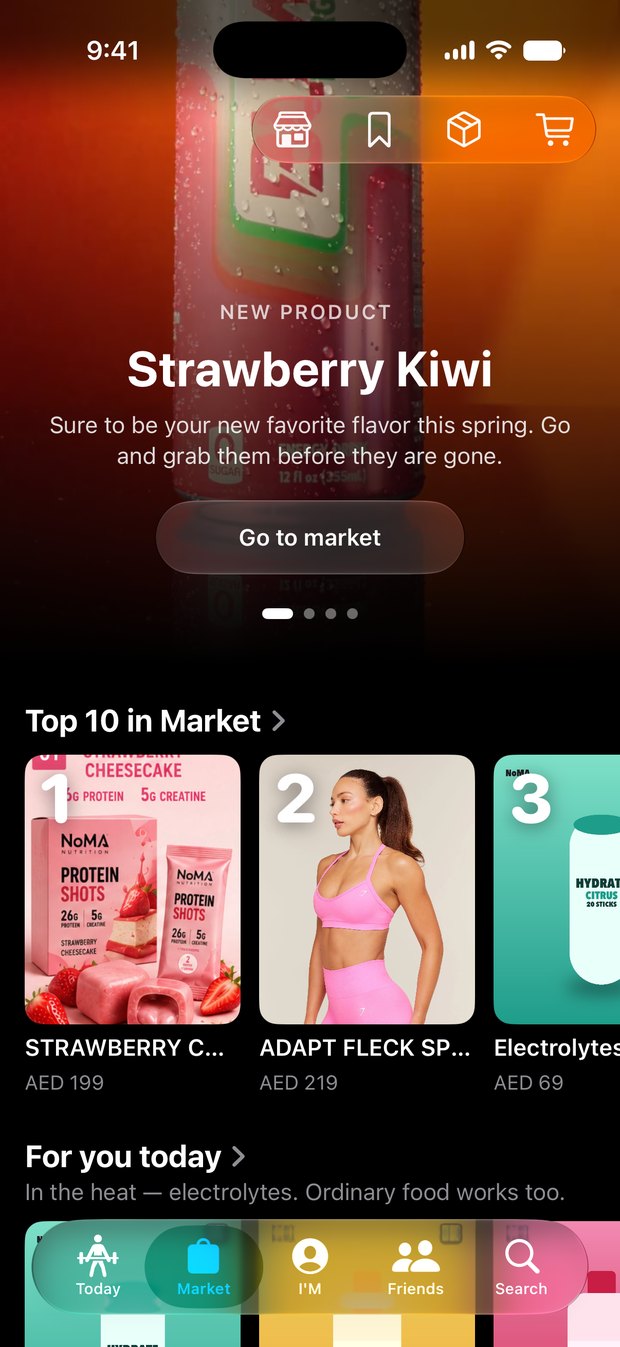
Sellers run their own shops inside the app. When a review comes from someone who actually bought the thing, it says so, so the rating is worth reading.

List what you take and we will flag it when the same thing turns up in two different jars. What we won’t do is tell you it’s too much. It depends on the form it comes in, your age and whatever else you are taking, and none of us here is qualified to draw that line.

No third-party advertising and no paid placement: nobody can buy their way up your screen. We make money from subscriptions and a share of what sellers sell.

The NomaSports market: banner, top 10 and a “For you today” shelf.
The shop, as it looks today. Some products are demo items.

Verified purchase

We check the receipt before the badge goes on.

Your supplements, cross-checked

Two jars with the same thing in them? We’ll say so. We never guess what’s inside a jar we haven’t seen.

In development

Recovery formulas

Personalised recovery nutrition matched to your own training and recovery, developed with qualified specialists. Nothing on sale yet, and no claims made.

Where we’re going

One person,
not the average in a table

Most advice is written for an average person who does not exist. We build around one person, not around a workout: how they sleep, how they recover, what fills their day and what genuinely works for them. Everything else — training, nutrition, the people nearby — grows on that spine.

Now

Today’s weight, the voice logging, the camera, your baseline, the people in your gym. All of it works today, and it is free.

Next

A voice that acts

“Noma, what do I need right now?” — and you get a plan for this moment, not a tip from a handbook. Any kind of load, not only the gym.

Then

Nutrition in a different format

A product assembled for your day from your data, not a tub off the shelf. It is made the way food is made for people who cannot afford to get it wrong, with a signed formula and with partners who know how to make it.

Always

Nothing about your body goes live until someone has put their name to the method behind it. That rule is why anything we do say is worth reading.

Build with us

Don’t just use it.
Help build it.

Three ways in, depending on what you have to give. None of them takes money right now.

Free now

Founding Partner

  • ✓ Your own partner number
  • ✓ Early and beta access
  • ✓ A vote on what gets built next
  • ✓ Partner pricing when subscriptions open
  • ✓ Private community
Become a partner →

The planned $20 founding tier opens once we’ve settled how it works legally. Until then joining is free and nothing is charged.

Your expertise

Founding Expert or Coach

  • ✓ Shape the method, not just review it
  • ✓ Put your name to the method
  • ✓ Named on the work you stand behind
Apply as an expert or coach

Coaches and personal trainers, physicians, nutrition scientists, physiotherapists, exercise physiologists, researchers. Selected experts may be invited to join the founding team, scientific board or advisory network — subject to role, contribution and formal agreements.

$1K → $3M+

Founding Investor

  • ✓ Small amounts through a licensed crowdfunding platform, once it opens
  • ✓ Larger amounts privately or in a round, on signed documents
  • ✓ Identity and eligibility checks for everyone
How investing works

Nothing is charged here, and this isn’t an offer of securities. Investment never runs through the same checkout as a pre-order. It goes through checks, documents and the appropriate legal structure, outside the app.

A nutrition brand, a manufacturer, a gym or a sports organization? That is a partnership — see the partners page. Any question at all: write to us.

Plainly

What we don’t do

Decisions we made on purpose, and don’t intend to change.

We don’t make you count calories

Almost everyone gives up typing food in by hand within a few weeks. Here you don’t: snap the plate or say it out loud, and calories, protein, fat and carbs are counted for you.

We don’t count streaks

A streak turns one missed day into a failure. You came back. That’s the part worth noticing.

We don’t sell your data

Your sleep hours and recovery figures stay with us. What the AI sees is a short code such as "slept less than usual", never the number itself.

We don’t interrogate you

No sign-up quiz, no questions about your weight. You can start without an account at all, and your sets get logged even when there’s no signal.

The longer you use it, the more it is yours

Day one it is an app.
A year in, it is you

You put in two seconds a set and one word after a meal. What comes back is something that exists nowhere else: how your body actually answers heat, a heavy week, a short night.

Three nights

It stops comparing you with a table and starts comparing you with you. From then on “seven hours” means something different for you than for the person next to you.

Two weeks

Today's weight comes from your last session and your last night — not from a programme written for somebody else.

Six months

Not a feeling that things are better. A number you can point at, next to the one you started with.

A year

A record of how your body answers. Nobody can hand that to a new user on day one — not us, not anyone. Which is why it is yours.

Your data stays yours. Sleep and pulse from your devices go to no outside AI, and blood-test results stay on your phone. There are no ads, and nobody can buy a place on the screen.

Start

You already have the data.
Now get the answer.

The app is not in the App Store yet. Leave your email and we will write to you once, on the day it opens.

That is one email, on launch day. No newsletter. We do not ask for your name or your number, and the address is not used for anything else.